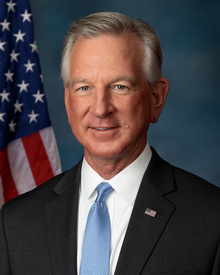
155 late STOCK Act filings. $200 statutory fine apiece. A seat on Armed Services. Defense-sector trades.
Complete STOCK Act trading history for Sen. Tommy Tuberville (R-AL) — every filing,
sector exposure, and AI signal score, cross-referenced against his Armed Services Committee assignment,
bill activity, and campaign contributions. See the STOCK Act law,
the disclosure gap pillar, and the
scoring methodology for context.
Live · STOCK Act tracked
Coverage: 2021–presentUpdated May 2026
TT
RSen./Republican/Armed Services · Agriculture
Tommy Tuberville
Alabama/U.S. Senate
In Senate since 2021/Declared net worth ~$5.5M(2025 PFD)/Trades own account directly
The poster-child STOCK Act violator. 155 late filings at the $200 statutory fine — $31,000 in maximum penalties, roughly a 1% cost against $3.1M in late-disclosed trade volume. He still sits on Armed Services, the committee that writes the Pentagon's procurement budget.
Cross-referenced: late filings (gap > 45 days) × Senate Armed Services roster.
1,726
Trades Filed
289
Unique Tickers
$52.1M
Est. Volume
155
Late Filings (>45d)
$3.1M late-disclosed
$2.1M
Defense Exposure
on Armed Services
D
Quality Tier
37% buy win rate
Sector Exposure · By trade countDefense-heavy · Armed Services adjacent
All data from public STOCK Act filings, cross-referenced by GovGreed with committee assignments,
bill activity, and campaign contributions. Updated daily.
A $5.5M senator trading $52M
~$5.5M
Declared net worth (2025 PFD)
$52.1M
5-year trading volume
~9×
Volume vs. net worth
He’s not a Pelosi or a Khanna. Tuberville’s declared net worth is modest by Senate standards — assets of $7.0M against $1.5M in debt. Yet he has churned $52.1M across 1,726 trades, including 63 options positions and the SPDR Aerospace & Defense ETF (XAR) — while sitting on the Armed Services Committee that authorizes the Pentagon’s budget. See where his ~$5.5M ranks among 450 members on the Congressional Net Worth leaderboard →
Section 01 · Trading Overview
Trading Overview
Tommy Tuberville stock trades have drawn intense public scrutiny since his first Senate term began in January 2021. The former Auburn University football coach arrived in Washington with no legislative experience but quickly became one of the Senate's most active stock traders, filing approximately 1,726 trades in his first five years. According to GovGreed's analysis of 103,887 STOCK Act filings, Tuberville ranks among the top traders in the upper chamber by both frequency and dollar volume.
Unlike many senators who rely on blind trusts or index funds, Tuberville actively trades individual stocks across sectors where his committee assignments give him access to non-public information. His estimated trading volume of $52.1 million spans defense contractors, biotech firms, energy companies, and technology stocks. GovGreed's signal scoring engine assigns Tuberville a D-tier quality rating (45.0 quality score) — his buy win rate is just 37% and his average trade has underperformed the S&P 500 — based on a composite model that weighs committee alignment, bill correlation, and trade timing.
Senator Tuberville has accumulated 155 documented STOCK Act violations — trades that were not disclosed within the legally required 45-day window. These late filings represent approximately $3.1 million in undisclosed trades, making his violation record one of the largest in Congress by both count and dollar value.
Under the STOCK Act of 2012, members of Congress must publicly disclose all stock transactions within 45 days. Each late filing carries a maximum fine of $200 — a penalty that critics describe as meaningless for senators trading in the six- and seven-figure range. For context: if a private citizen filed 155 late SEC disclosures, the consequences would likely be far more severe than $31,000 in total fines.
By the numbers: 155 violations at $200 each = $31,000 in maximum fines on $3.1 million in undisclosed trades. That is a penalty rate of 1% — less than most credit card processing fees.
Across all of Congress, 12,559 deduplicated trades (12.1%) were filed beyond the 45-day deadline. The average disclosure gap for all 353 trading politicians is 49 days. Tuberville's late filing rate significantly exceeds this baseline.
Timeline of Key Violations
January 2021
Tuberville takes office. Within weeks, he begins actively trading individual stocks without setting up a blind trust.
September 2021
Business Insider reports Tuberville has failed to properly disclose dozens of stock trades. He initially claims the disclosures were filed on time and blames a staffer for the errors.
February 2022
As the Russia-Ukraine conflict escalates, Tuberville's filings show trades in defense and energy stocks that coincide with his Armed Services Committee briefings on the conflict.
2022–2023
Additional late filings accumulate. Despite bipartisan calls for stricter enforcement, Tuberville continues trading individual stocks. His total violation count reaches triple digits.
2024–2026
Tuberville's violation count reaches 155. Multiple congressional stock-trading ban proposals — including the bipartisan TRUST in Congress Act — cite his trading record as evidence that self-policing has failed.
Section 03 · Armed Services × Defense Stocks
Armed Services Committee & Defense Stock Trades
The most scrutinized aspect of Tuberville's trading is the overlap with his Armed Services Committee assignment. This committee receives classified briefings on defense budgets, military operations, weapons procurement, and geopolitical threats — information that directly affects the stock prices of defense contractors.
Tuberville's filings show trades in defense-sector companies including RTX (Raytheon Technologies), Lockheed Martin (LMT), and other military contractors. GovGreed's signal engine cross-references these trades with committee hearing dates, bill activity in the Armed Services Committee, and sector momentum to detect patterns of potential information asymmetry.
Why This Matters
Classified briefings: Armed Services members receive regular classified updates on military operations, procurement decisions, and threat assessments
Defense budget authority: The committee writes the annual National Defense Authorization Act (NDAA), a $886 billion spending bill that directly impacts contractor revenue
Ukraine-Russia conflict: Tuberville traded defense stocks during the 2022 Russian invasion of Ukraine while receiving classified intelligence briefings on the conflict
Agriculture Committee overlap: His second committee assignment (Agriculture) gives additional access to crop data, trade policy, and commodity market intelligence
GovGreed signal detection: The platform's bill-trade correlation engine found statistically significant timing patterns between committee activity and Tuberville's trading
GovGreed does not make legal accusations. The data shows a pattern of trading in sectors where committee assignments create information advantages. Whether this constitutes illegal insider trading is a legal determination for the SEC and DOJ. GovGreed quantifies these patterns objectively across 256,112 bill-trade correlations covering all of Congress. Not financial advice.
Sector Exposure
Tuberville's portfolio is diversified across multiple sectors, but the concentration in defense, energy, and biotech stands out given his committee assignments. Below is a breakdown of his disclosed trades by sector, based on GovGreed's mapping of tickers to GICS sectors.
■■■
Sector Breakdown
Loading sector data...
Disclosure Gap Analysis
The STOCK Act requires trades to be disclosed within 45 days. Across all of Congress,
12,559 deduplicated trades (12.1%) were filed late. The average disclosure gap across the full
database is 49 days. Tuberville's filing patterns tell a more troubling story.
Tuberville avg disclosure gap39.0 days
Congress-wide average49 days
Tuberville trades filed late (>45 days)155 of 1,651 (9.4%)
Longest single disclosure gap403 days
Late filings matter because they extend the information asymmetry window — the period during
which the senator knows his positions but the public does not. For a senator on the Armed Services Committee
trading defense stocks, every additional day of non-disclosure represents an informational advantage
that ordinary investors cannot access. GovGreed flags every late filing automatically across all
12,559 late-filed trades in the database.
Frequently Asked Questions
How many stock trades has Tommy Tuberville made?▼
Senator Tommy Tuberville (R-AL) has made approximately 1,726 stock trades since entering the Senate in January 2021. These trades span defense contractors, biotech, energy, and technology sectors with an estimated total volume of $52.1 million. All trades are disclosed through mandatory STOCK Act filings and tracked in GovGreed's database of 103,887 congressional trades across 353 politicians.
What stocks does Tommy Tuberville trade?▼
Tuberville's STOCK Act filings show positions across multiple sectors including defense contractors like RTX (Raytheon) and Lockheed Martin (LMT), biotechnology companies, energy stocks, and broad-market ETFs. His trading is notable for the overlap with his Armed Services Committee assignment, which gives him access to classified defense briefings and non-public information about military contracts. The full list of his traded tickers is visible in the table above and on his GovGreed profile page.
Did Tuberville violate the STOCK Act?▼
Yes. Senator Tuberville has accumulated 155 documented STOCK Act violations, representing approximately $3.1 million in trades that were not disclosed within the legally required 45-day window. Under the STOCK Act, each late filing carries a $200 fine. His violations are among the largest in Congress by both count and dollar value. Despite this record, he has faced no penalties beyond the nominal fines.
Does Tuberville trade defense stocks?▼
Yes. Tuberville has traded defense-sector stocks including RTX (Raytheon), Lockheed Martin (LMT), and other military contractors while serving on the Senate Armed Services Committee. This committee receives classified briefings on defense spending, military contracts, and geopolitical intelligence. GovGreed's signal engine cross-references these trades with committee assignments to detect potential information asymmetry. Not financial advice.
How does Tuberville compare to other senators?▼
With 1,726 trades, Tuberville is one of the most active stock traders in the Senate. His 155 STOCK Act violations place him among the worst compliance records in Congress. For context, across all 353 trading politicians, the average disclosure gap is 49 days, and 12.1% of all trades (12,559) are filed late. Tuberville's late filing rate and total violation count both exceed congressional averages significantly. His D-tier quality rating (45.0) reflects weak risk-adjusted results — a 37% buy win rate, with trades that have on average underperformed the market.
Is Tuberville's stock trading legal?▼
Members of Congress are legally permitted to trade individual stocks under current law. The STOCK Act of 2012 requires disclosure within 45 days but does not ban trading. Whether any specific trade constitutes illegal insider trading is a legal determination made by the SEC and DOJ. Tuberville's late filings violate the STOCK Act's disclosure requirements, carrying a $200 fine per violation. Multiple bipartisan proposals to ban congressional stock trading — including the TRUST in Congress Act — have been introduced but none have passed. GovGreed tracks the data; it does not make legal accusations.
How to track Tommy Tuberville's stock trades?▼
Track Tuberville's trades through GovGreed's free dashboard, which aggregates all STOCK Act filings daily from the Senate eFD system. GovGreed cross-references each trade with committee assignments, bill activity, campaign contributions, and lobbying data to generate a composite signal score. Set up alerts to be notified when new Tuberville filings appear. The database covers 103,887 trades from 353 politicians across 14 years (2012–2026).
What is Tuberville's stock trading record?▼
Tuberville's trading record shows approximately 1,726 trades with an estimated volume of $52.1 million since entering the Senate in January 2021. GovGreed's analysis indicates a buy win rate of approximately 37% with an average excess return of -8.8% versus the S&P 500. His trader quality tier is D (45.0 quality score) based on GovGreed's composite scoring model that weighs politician quality, herd detection, bill correlation, technical context, sector momentum, campaign contributions, and lobbying alignment. His 155 STOCK Act violations total roughly $3.1 million in undisclosed trades. Not financial advice.
See interactive charts, signal scores, sector drilldowns, and trade-by-trade analysis with real-time alerts on every defense-sector buy ahead of Armed Services markup.
Top 10 signals + 10 AI questions a day on the free tier · Founders locked at $24.50/mo forever
About This Data:
Statistics sourced from Congress.gov, SEC EDGAR, FEC, and Senate LDA via official APIs.
Database: 103,887 trades, 353 politicians, 14 years (2012–2026).
Updated daily. Not financial advice. All data from public federal disclosures.