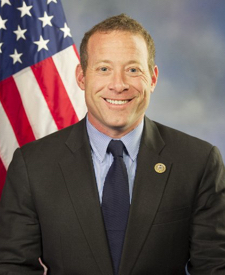
Rep. Josh Gottheimer (D-NJ5) sits on the House Financial Services Committee
— the committee that writes the rules for banking, the SEC, the Federal Reserve, securities law,
and cryptocurrency regulation. He has filed 3,461 STOCK Act disclosures totaling
approximately $224.2M across 549 tickers, including
130 disclosed call options — a rarity among congressional traders. His district
(NJ-5) is a wealthy NYC commuter corridor where Wall Street professionals live. Every position
cross-referenced against the banking, securities, and crypto bills under his committee's oversight.
New Jersey's 5th District · NYC Commuter Corridor/U.S. House of Representatives
In Congress since 2017/Co-chair, Problem Solvers Caucus/Active options trader (59 calls disclosed)
Among the top 3 most active congressional traders — $224.2M across 3,461 disclosures and 549 tickers. The seat: House Financial Services. The committee that writes the rules for banking, securities, and crypto. The portfolio: 130 disclosed call options on the stocks it regulates.
Cross-referenced: 99,546 STOCK Act filings × House Financial Services markup calendar
—
Trades Filed
—
Unique Tickers
—
Est. Volume
59
Call Options Disclosed
rare in Congress
Top 3
Trader Rank by Volume
behind Khanna + McCaul
HFS
Committee Seat
banking + securities
Sector Exposure · Across 549 tickersFinancials over-weight · aligned with committee
All data from public STOCK Act filings, cross-referenced by GovGreed with committee assignments,
bill activity, and campaign contributions. Updated daily.
Section 01 · Trading Overview
Trading Overview
Josh Gottheimer stock trades stand out for two reasons: $224.2M in disclosed volume across 3,461 STOCK Act filings places him among the top 3 most active congressional traders (behind Ro Khanna and Michael McCaul), and his filings include 130 disclosed call options — a rarity in Congress, where most members trade only stock. He sits on the House Financial Services Committee, the panel that writes banking, securities, capital-markets, housing-finance, and cryptocurrency law.
According to GovGreed's analysis of 99,546 total STOCK Act filings from 354 members, Gottheimer's portfolio spans 549 unique tickers across technology, financials, healthcare, consumer, and industrial sectors — with a notable financials overweight that aligns directly with his HFS Committee oversight. GovGreed's signal scoring engine cross-references each trade with his committee assignments, the bills moving through HFS markup, campaign contributions from financial-services PACs, and the lobbying calendar of banks, broker-dealers, and crypto firms regulated by the committee.
Gottheimer ranks #3 in Congress by lifetime STOCK Act filing volume, behind only Ro Khanna (24,991 trades) and Michael McCaul (16,488 trades). At 3,461 disclosed trades since 2017, his pace works out to roughly 14 trades per week, every week — high enough to suggest professionally managed accounts but with one critical distinction from the other two: he discloses call options.
Of Gottheimer's 3,461 filings, GovGreed counts approximately 130 disclosed call-option trades. Call options are leveraged directional bets — they profit when the underlying stock rises and typically expire worthless if the bet is wrong. Active options trading is unusual in Congress, where the vast majority of disclosed trades are passive stock buys and sells. Of the top 10 most-active congressional traders by volume, Gottheimer has one of the highest disclosed option-contract counts in the House.
Dollar volume context: Gottheimer's $224.2M in disclosed lifetime trading ranks him in the top 5 by dollar volume in the entire House. The average House member with any disclosed trading has roughly $4.2M in lifetime volume — Gottheimer is at approximately 52× the House median.
For comparison: Pelosi's household has fewer disclosed trades than Gottheimer but larger dollar sizes per trade (concentrated in NVDA/AAPL/MSFT positions worth millions each). Khanna has 7× Gottheimer's filing count but lower per-trade dollar amounts (broker-managed diversified ETF rotation). Gottheimer sits in the middle: enough volume to suggest managed accounts, with the only option-trading footprint that signals conviction.
Section 03 · HFS × Banking Portfolio
House Financial Services Committee Member Trading Bank Stocks
Josh Gottheimer sits on the House Financial Services Committee — the panel with direct legislative jurisdiction over banking, securities, capital markets, housing finance, monetary policy, and cryptocurrency. The committee oversees the SEC, the FDIC, the Federal Reserve, the OCC, and the CFPB. It marks up the legislation that governs how big banks, broker-dealers, asset managers, fintechs, and crypto firms operate.
His STOCK Act filings show substantial positions in financial-sector stocks. Of his 3,461 lifetime trades, approximately 24% are in companies directly under HFS jurisdiction — including JPMorgan (JPM), Visa (V), BlackRock (BLK), Mastercard (MA), and other financial-services firms whose business models depend on the regulatory framework the committee writes. He also represents a district (NJ-5) where many constituents work on Wall Street, giving him constant proximity to industry information flows.
Why This Matters
House Financial Services Committee oversight: Direct jurisdiction over the SEC, Federal Reserve, FDIC, and CFPB — the agencies that regulate the companies in his portfolio
Crypto + securities legislation: HFS marks up every major bill that moves crypto, fintech, and broker-dealer share prices — advance knowledge is structurally part of the seat
130 disclosed call options: Leveraged directional bets that profit when stocks rise. Among the highest disclosed options counts in the House — signals conviction trading, not passive allocation
NJ-5 district = Wall Street commuter belt: Many constituents are bankers, traders, and asset managers — constant industry proximity beyond formal committee channels
Problem Solvers Caucus co-chair: Bipartisan leadership role gives access to cross-aisle negotiations on financial-sector and crypto policy
GovGreed signal detection: The platform's bill-trade correlation engine analyzes 440,806 correlations to detect timing patterns between HFS markup events and Gottheimer's trades
GovGreed does not make legal accusations. The data shows a structural overlap: a House Financial Services Committee member trades $224.2M across the companies his committee regulates, including 130 disclosed call options. Whether any specific trade constitutes illegal insider trading is a legal determination for the SEC and DOJ. GovGreed quantifies these patterns objectively across 440,806 bill-trade correlations covering all of Congress. Not financial advice.
Sector Exposure
Gottheimer's 3,461 trades span 549 unique tickers, with a notable financials overweight
reflecting his House Financial Services Committee seat. The chart below ranks sectors by trade count and
marks the sectors that overlap with his committee oversight — the ones where trade timing carries
potential information advantage. Sector mapping uses GovGreed's GICS classification.
Strategic Profile
Gottheimer sits on the House Financial Services Committee, which has direct legislative jurisdiction
over banking, securities, capital markets, and cryptocurrency. He also serves on Veterans' Affairs and
co-chairs the bipartisan Problem Solvers Caucus. Below is GovGreed's AI-composed strategic dossier
mapping his $224.2M / 3,461-trade portfolio against committee assignments, donor industries, and the
bills that frame the financial-services regulatory landscape.
Disclosure Gap Analysis
The STOCK Act requires trades to be disclosed within 45 days. Across all of Congress,
12,766 deduplicated trades (12.8%) were filed late. The average disclosure gap across the full
database is 50 days. Here is how Gottheimer's filing patterns compare.
Gottheimer avg disclosure gap—
Congress-wide average50 days
Gottheimer trades filed late (>45 days)—
Longest single disclosure gap—
Late filings matter because they extend the information asymmetry window — the period during
which the representative knows his positions but the public does not. For a House Financial Services Committee
member trading $224.2M in stocks the committee regulates — and disclosing 130 call options on those same
stocks — every additional day of non-disclosure represents an informational advantage that ordinary
investors cannot access. GovGreed flags every late filing automatically across all
12,766 late-filed trades in the database.
Frequently Asked Questions
How many stock trades has Josh Gottheimer made?▼
Representative Josh Gottheimer (D-NJ5) has filed approximately 3,461 STOCK Act disclosures totaling around $224.2 million in trading volume across 549 unique tickers — placing him among the top 3 most active stock traders in Congress, behind only Ro Khanna (24,991) and Michael McCaul (16,488). His filings break down to roughly 1,441 purchases, 2,018 sales, and 130 disclosed call options. All trades are disclosed through mandatory STOCK Act filings and tracked in GovGreed's database of 99,546 deduplicated congressional trades from 354 members.
Why is Josh Gottheimer's stock trading controversial?▼
Gottheimer sits on the House Financial Services Committee — the committee with direct legislative jurisdiction over banking, securities, capital markets, and cryptocurrency regulation. He is among the top 3 most active traders in Congress while serving on the committee that regulates the industry his portfolio is heavily exposed to. He has also disclosed 130 call options, a rarity among congressional traders, suggesting active directional bets rather than passive index investing. The combination of HFS oversight and $224.2M in disclosed trading volume creates a structural conflict of interest that GovGreed surfaces in the Strategic Profile above.
What stocks does Josh Gottheimer trade?▼
Gottheimer's STOCK Act filings show positions across 549 unique tickers spanning technology, financials, healthcare, and industrial sectors. His district (NJ-5) is a wealthy commuter corridor for Wall Street professionals, and his portfolio reflects broad equity exposure typical of professionally managed accounts in that region. Notable: 130 disclosed call option positions place him in the small group of congressional members who actively trade options. The full sector breakdown is visible in the chart above and the trade table.
Is Josh Gottheimer on the House Financial Services Committee?▼
Yes. Gottheimer sits on the House Financial Services Committee, which has direct legislative jurisdiction over banking, securities, capital markets, housing finance, monetary policy, and cryptocurrency regulation. The committee oversees the SEC, FDIC, Federal Reserve, OCC, and CFPB. He also serves on the House Veterans' Affairs Committee and co-chairs the bipartisan Problem Solvers Caucus. The structural overlap between HFS oversight and his $224.2M in disclosed trading volume is what GovGreed surfaces in the Strategic Profile above.
Does Josh Gottheimer trade options?▼
Yes. Gottheimer has disclosed approximately 59 call option positions in his STOCK Act filings — among the highest disclosed options counts in the House. Call options are leveraged directional bets that profit when the underlying stock rises (and typically expire worthless if the bet is wrong). Active options trading is unusual in Congress, where most members file only stock purchases and sales. Gottheimer's options activity, combined with his House Financial Services seat, makes his disclosure record one of the most-watched on Capitol Hill.
How does Gottheimer compare to other top traders in Congress?▼
Gottheimer is among the top 3 most active congressional traders by filing volume, behind Ro Khanna (24,991 trades) and Michael McCaul (16,488 trades). His ~3,461 trades represent a high-volume, professionally-managed pattern. Unlike Khanna and McCaul (both also professionally managed), Gottheimer's filings include 130 disclosed call options — placing him in a small group of members who actively trade derivatives. His $224.2M total disclosed volume ranks him in the top 5 by dollar volume in the House.
How to track Josh Gottheimer's stock trades?▼
Track Gottheimer's trades through GovGreed's free dashboard, which aggregates all STOCK Act filings daily from the House Financial Disclosures system. GovGreed cross-references each trade with committee assignments (notably House Financial Services), bill activity, campaign contributions, and lobbying data to generate a composite signal score. Set up alerts to be notified when new Gottheimer filings appear. The database covers 99,546 trades from 354 members across 14 years (2012–2026).
Has Josh Gottheimer violated the STOCK Act?▼
Gottheimer's late-filing rate is approximately 8.1% — 281 of his 3,461 deduplicated filings past the 45-day deadline, below the congressional average of 12.8%. The STOCK Act of 2012 requires disclosure within 45 days; late filings carry a $200 fine per violation. Across all of Congress, 12,766 deduplicated trades (12.8%) were filed late. GovGreed tracks the data objectively and does not make legal accusations. Not financial advice.
Top 10 signals + 10 AI questions a day on the free tier · Founders locked at $24.50/mo forever
About This Data:
Statistics sourced from Congress.gov, SEC EDGAR, FEC, and Senate LDA via official APIs.
Database: 99,546 trades, 354 members, 14 years (2012–2026).
Updated daily. Not financial advice. All data from public federal disclosures.