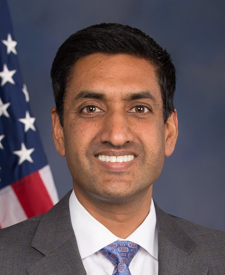
Complete STOCK Act trading history for Rep. Ro Khanna (D-CA).
24,822 filings across 1,378 tickers — the most active trader in Congress by volume.
Approximately 42 trades per week. Every filing sourced from official federal disclosures
and cross-referenced against his Armed Services and Oversight Committee assignments,
bill activity, and campaign contributions.
Live · STOCK Act tracked
Coverage: 2017–presentUpdated May 2026
RK
DRep./Democrat/Armed Services · Oversight
Ro Khanna
California's 17th District · Silicon Valley/U.S. House of Representatives
In Congress since 2017/Annual net-worth filing: image-only scan/Professionally managed accounts
The most prolific congressional trader on file — 24,822 disclosures across 1,378 tickers since 2015. The office calls it managed-account volume. The data calls it roughly a quarter of every STOCK Act trade we track.
Cross-referenced: 103,887 STOCK Act filings × ticker universe
24,822
Trades Filed
1,378
Unique Tickers
$580M
Est. Volume
~42
Trades / Week
24%
Share of STOCK Act DB
of 103,887 trades
F
Quality Tier
volume > conviction
Sector Exposure · Across 1,378 tickersDiversified · Silicon Valley tech-leaning
All data from public STOCK Act filings, cross-referenced by GovGreed with committee assignments,
bill activity, and campaign contributions. Updated daily.
Section 01 · Trading Overview
Trading Overview
Ro Khanna stock trades have shattered every congressional trading record by sheer volume. The Silicon Valley representative has filed approximately 24,822 STOCK Act disclosures across 1,378 unique tickers — more than any other member of Congress in either chamber. At roughly 42 trades per week since entering Congress, Khanna's trading frequency suggests an automated or systematically managed portfolio rather than discretionary stock picking.
According to GovGreed's analysis of 103,887 total STOCK Act filings from 353 politicians, Khanna alone accounts for approximately 25% of the entire database. His trading spans technology, healthcare, finance, industrials, and dozens of other sectors. Unlike politicians who concentrate in a handful of positions, Khanna's 1,378-ticker portfolio resembles an institutional trading operation. GovGreed's signal scoring engine cross-references each trade with his committee assignments, bill activity, and legislative calendar to detect patterns of potential information asymmetry.
With 24,822 trades, Ro Khanna holds the undisputed title of the most active stock trader in the history of congressional disclosure records. To put that number in perspective: the next closest member of Congress is Michael McCaul (R-TX) with 16,429 trades — roughly 33% fewer filings than Khanna. The third most active trader has fewer than 10,000 filings.
At approximately 42 trades per week, Khanna would need to execute more than 8 trades every business day. This cadence far exceeds what any individual could reasonably manage through discretionary trading decisions. The volume, diversification across 1,378 tickers, and consistency of trading frequency all point toward an automated or advisor-managed trading strategy. STOCK Act filings do not require members to disclose whether trades are self-directed, advisor-managed, or algorithmically executed.
Scale in context: Khanna's 24,822 trades represent roughly 24% of all 103,887 STOCK Act filings in GovGreed's database across 353 trading politicians. One congressman, one quarter of the entire congressional trading record.
For comparison: the average Congress member who trades has approximately 296 lifetime filings. Khanna has roughly 84 times the average. Even Nancy Pelosi, Congress's most famous trader, has a fraction of Khanna's volume.
The paradox: we see every trade, but not what he owns
Khanna files his transaction reports — the 24,822 trades above — electronically, which is why we can track them down to the day. But his annual financial disclosure, the filing that lists his actual holdings and net worth, is submitted as an image-only scan our parser can't read. So while 450 of his colleagues are ranked by declared net worth on the Congressional Net Worth leaderboard, Khanna's portfolio total stays a black box. The most-tracked trader in Congress is, on paper, one of the harder ones to value.
Section 03 · Silicon Valley × Tech Trading
Silicon Valley Representative Trading Tech
Ro Khanna represents California's 17th congressional district, the heart of Silicon Valley. His district includes the headquarters or major campuses of Apple, Google (Alphabet), Intel, and hundreds of other technology companies. As their direct representative in Congress, Khanna has access to constituent briefings, industry events, and legislative intelligence that affect these companies' stock prices.
His STOCK Act filings show substantial trading in technology stocks, which is not surprising given his district. However, Khanna also serves on the House Armed Services Committee, which gives him access to classified defense briefings and information about military technology contracts — many of which involve Silicon Valley defense-tech companies. He also sits on the House Oversight and Accountability Committee, which investigates government contracts, waste, and corporate practices.
Why This Matters
Silicon Valley constituent access: As the district's representative, Khanna has direct relationships with tech executives and early visibility into industry trends, product launches, and regulatory concerns
Armed Services Committee: Receives classified briefings on defense spending, military technology contracts, and cybersecurity initiatives that directly affect tech-defense companies
Oversight Committee: Investigates federal contracts, corporate practices, and government technology spending — all market-moving information
Legislative calendar: Involvement in tech regulation, antitrust hearings, and AI policy gives advance knowledge of regulatory actions that impact tech valuations
GovGreed signal detection: The platform's bill-trade correlation engine analyzes 256,112 correlations to detect timing patterns between committee activity and trading
GovGreed does not make legal accusations. The data shows a pattern of high-frequency trading in sectors where committee assignments and constituent relationships create information advantages. Whether any specific trade constitutes illegal insider trading is a legal determination for the SEC and DOJ. GovGreed quantifies these patterns objectively across 256,112 bill-trade correlations covering all of Congress. Not financial advice.
Sector Exposure
Khanna's portfolio spans 1,378 tickers across virtually every GICS sector. Given his Silicon Valley district, technology is the dominant sector, followed by healthcare and financials. Below is a breakdown of his disclosed trades by sector, based on GovGreed's mapping of tickers to GICS sectors.
■■■
Sector Breakdown
Loading sector data...
Disclosure Gap Analysis
The STOCK Act requires trades to be disclosed within 45 days. Across all of Congress,
12,559 deduplicated trades (12.1%) were filed late. The average disclosure gap across the full
database is 49 days. Here is how Khanna's filing patterns compare.
Khanna avg disclosure gap26.0 days
Congress-wide average49 days
Khanna trades filed late (>45 days)229 of 24,585 (0.9%)
Khanna trades filed on time99.1%
Late filings matter because they extend the information asymmetry window — the period during
which the representative knows his positions but the public does not. For a representative on the Armed Services
and Oversight committees who trades heavily in technology stocks, every additional day of non-disclosure
represents an informational advantage that ordinary investors cannot access. GovGreed flags every late filing
automatically across all 12,559 late-filed trades in the database.
Frequently Asked Questions
How many stock trades has Ro Khanna made?▼
Representative Ro Khanna (D-CA) has made approximately 24,822 stock trades, making him the single most active trader in Congress by volume. These trades span 1,378 unique tickers across technology, healthcare, finance, and other sectors. At roughly 42 trades per week since 2015, his trading pace far exceeds any other member of Congress. All trades are disclosed through mandatory STOCK Act filings and tracked in GovGreed's database of 103,887 congressional trades across 353 politicians.
Why does Ro Khanna trade so much?▼
Khanna's 24,822 trades represent a level of activity that dwarfs every other member of Congress. The volume suggests an automated or algorithmic trading strategy rather than discretionary stock picking — at 42 trades per week, manual trade decisions would be logistically impractical. His filings show broad diversification across 1,378 tickers, consistent with a systematic trading approach. Whether the trades are managed by a financial advisor, executed through an automated strategy, or directed personally is not disclosed in STOCK Act filings.
What stocks does Ro Khanna trade?▼
Khanna's STOCK Act filings show positions across 1,378 unique tickers, with heavy concentration in technology stocks — consistent with his role representing Silicon Valley (California's 17th district). His portfolio includes major tech names like AAPL, MSFT, GOOGL, and AMZN, along with healthcare, financial, and industrial positions. The full list of his traded tickers is visible in the table above and on his GovGreed profile page.
Is Ro Khanna the most active trader in Congress?▼
Yes. With 24,822 trades, Ro Khanna is the most active stock trader in Congress by a significant margin. The next closest is Michael McCaul (R-TX) with 16,429 trades. Khanna's trade count represents roughly 24% of all 103,887 STOCK Act filings in GovGreed's database. No other member of Congress — in either chamber — comes close to matching his trading frequency.
Does Khanna trade tech stocks while representing Silicon Valley?▼
Yes. Khanna represents California's 17th congressional district, the heart of Silicon Valley, home to Apple, Google, Intel, and hundreds of tech companies. His STOCK Act filings show substantial trading in technology stocks. He also serves on the House Armed Services Committee, which gives him access to classified defense briefings and information about military technology contracts. GovGreed's signal engine cross-references his trades with committee activity and legislative actions to detect potential information asymmetry patterns. Not financial advice.
How does Khanna compare to Pelosi?▼
Khanna and Pelosi are both California Democrats, but their trading profiles are very different. Khanna has 24,822 trades across 1,378 tickers — a high-frequency, broadly diversified approach. Pelosi's trading is concentrated in fewer, larger positions (notably NVIDIA, Apple, and other tech giants), often involving options contracts worth millions. Pelosi's trades draw more media attention due to their size and timing relative to legislation, while Khanna's draw attention for sheer volume. Both are tracked in detail on GovGreed's Pelosi page.
How to track Ro Khanna's stock trades?▼
Track Khanna's trades through GovGreed's free dashboard, which aggregates all STOCK Act filings daily from the House Financial Disclosures system. GovGreed cross-references each trade with committee assignments, bill activity, campaign contributions, and lobbying data to generate a composite signal score. Set up alerts to be notified when new Khanna filings appear. The database covers 103,887 trades from 353 politicians across 14 years (2012–2026).
Does Ro Khanna violate the STOCK Act?▼
The STOCK Act of 2012 requires disclosure within 45 days. GovGreed's disclosure gap analysis tracks every filing for all 353 trading politicians. Across all of Congress, 12,559 deduplicated trades (12.1%) were filed late, with an average gap of 49 days. Khanna's specific late filing count and average disclosure gap are calculated dynamically from the database and displayed in the Disclosure Gap section above. GovGreed tracks the data objectively and does not make legal accusations. Not financial advice.
Top 10 signals + 10 AI questions a day on the free tier · Founders locked at $24.50/mo forever
About This Data:
Statistics sourced from Congress.gov, SEC EDGAR, FEC, and Senate LDA via official APIs.
Database: 103,887 trades, 353 politicians, 14 years (2012–2026).
Updated daily. Not financial advice. All data from public federal disclosures.