The Foreign Influence Map
When a foreign government wants something from Washington, it hires an American firm to ask — and the law makes that public. Across the FARA record, 7,066 firms have registered to represent 17,694 foreign-principal relationships from 273 countries. 812 are active today, and the live list looks nothing like the all-time one: the Gulf states have moved to the front.
The Foreign Agents Registration Act (FARA) requires anyone lobbying or doing public-relations work in the United States on behalf of a foreign principal to register with the Department of Justice and disclose the relationship. Across the FARA record, 7,066 registrant firms have declared 17,694 foreign-principal relationships spanning 273 countries; 812 are active today. The all-time leaders are Japan, Canada and Mexico — but the active list is led by Japan and, strikingly, the Gulf states: Saudi Arabia, Qatar and the United Arab Emirates together hold nearly a hundred live relationships. A small set of Washington firms brokers most of it — Mercury Public Affairs, BGR Government Affairs, Akin Gump and Squire Patton Boggs each have represented dozens of foreign principals across dozens of countries. FARA is a disclosure regime, not a prohibition; this paper maps what it discloses.
- Key findings
- 7,066 American firms have registered 17,694 foreign-principal relationships from 273 countries since the records began.
- 812 relationships are active today — the rest terminated, the residue of decades of accumulated registrations.
- The Gulf has moved to the front of the live list: Saudi Arabia (36), Qatar (32), UAE (28) — nearly 100 active relationships between them — behind only Japan (49).
- A handful of firms broker it: Mercury (17 active), BGR (14), Akin Gump (91 all-time / 44 countries), Squire Patton Boggs (141 / 77).
- FARA is a disclosure law, not a ban. Registering to represent a foreign client is legal; the law exists so the work is visible.
1. Introduction: the legal way to buy influence
A foreign government cannot vote in a U.S. election or sit in a committee hearing. What it can do — legally, and at scale — is hire an American firm to make its case: to lobby members of Congress, shape press coverage, and advise on strategy. Since 1938, the Foreign Agents Registration Act has required those firms to register with the Department of Justice and disclose who they work for, what they do, and what they are paid. The point of FARA is not to stop the influence; it is to make it visible.
That visibility is the dataset. Every registered relationship between an American “registrant” firm and a foreign “principal” — a government, a state-owned enterprise, a political party — is on the public record. This paper reads the whole ledger: how big it is, which countries buy the most representation, how the live picture differs from the historical one, and which Washington firms do the brokering.
2. Data and methodology
We use the DOJ FARA registration data as mirrored in GovGreed's fara_registrants and
fara_foreign_principals tables: 7,066 registrant firms and 17,694 foreign-principal
relationships tagged by country, each flagged active or terminated. We report both the all-time
totals (the full accumulated record) and the active snapshot (relationships not yet terminated, 812 of
them). Counts use COUNT(*) directly, since the FARA tables under-report in Postgres's row-statistics. All
figures were re-derived live on June 30, 2026.
Two cautions. First, the record is deep in time — it includes long-terminated relationships, and country labels reflect the era of filing (the data still carries “USSR”), so all-time country totals are a historical accumulation, not a current ranking; for “now,” use the active snapshot. Second, FARA captures registered foreign-agent work specifically; commercial lobbying registered under the separate Lobbying Disclosure Act, and any influence that never registers at all, are out of scope. This is the disclosed foreign-agent layer, not all foreign influence.
3. The active map: the Gulf moves to the front
The most interesting thing in the data is the gap between the all-time ranking and the live one. All-time, the FARA record is led by the United States' largest trading partners and allies — Japan, Canada, Mexico, Great Britain, France — decades of routine commercial and diplomatic representation. The active snapshot tells a more current story: Japan still leads, but the next three are Gulf monarchies.
Figure 1 · Foreign principals with active U.S. representation, by countryForeign principals with an active FARA registration, by country, today. The Gulf trio (Saudi Arabia, Qatar, UAE) holds ~96 active relationships between them. All-time, the leaders are Japan (1,176), Canada (820) and Mexico (580). Verified June 30, 2026.
The Gulf's prominence is the live signal. Saudi Arabia, Qatar and the UAE are not major U.S. trading partners on the scale of Japan or Canada; their place near the top of the active list reflects a deliberate, sustained investment in Washington representation — the kind of soft-power spending that shows up in FARA before it shows up anywhere else.
4. The brokers
Foreign governments do not lobby Washington directly; they rent the relationships and the know-how of established American firms. A small set of them dominates. Ranked by active foreign clients, Mercury Public Affairs leads with 17, followed by BGR Government Affairs and Sonoran/Stryk Global Diplomacy at 14 each. Ranked by all-time breadth, the big law-and-lobby shops tower: Squire Patton Boggs has represented 141 foreign principals across 77 countries, and Akin Gump 91 across 44.
Table 1 · The top foreign-agent firms (by active foreign clients)| Firm | Active | All-time | Countries |
|---|---|---|---|
| Mercury Public Affairs | 17 | 67 | 42 |
| Dickens & Madson (Canada) | 15 | 24 | 22 |
| BGR Government Affairs | 14 | 71 | 48 |
| Sonoran Policy Group / Stryk Global Diplomacy | 14 | 40 | 33 |
| MMGY Global | 14 | 32 | 27 |
| Continental Strategy | 11 | 14 | 12 |
| Brownstein Hyatt Farber Schreck | 10 | 32 | 24 |
| Akin Gump Strauss Hauer & Feld | 9 | 91 | 44 |
| Squire Patton Boggs | 8 | 141 | 77 |
FARA registrant firms ranked by active foreign-principal relationships; all-time totals and distinct-country breadth shown alongside. Squire Patton Boggs and Akin Gump are full-service law/lobby shops with the deepest historical foreign books. Verified June 30, 2026.
5. Discussion: the disclosed layer of a hidden market
FARA is the one corner of the influence economy that is, by design, fully public — and even so it captures only part of the picture. Commercial lobbying flows through the separate Lobbying Disclosure Act; issue advocacy, think-tank funding, and informal access leave fainter trails. What FARA gives is a clean, checkable spine: the foreign governments willing to put their name to a registered relationship, and the American firms willing to sign for them. Read against GovGreed's domestic money-trail work — the contracts the government pays out and the rules it rewrites — FARA completes the map from the other direction: the money flowing into Washington's attention from abroad.
6. Limitations and caveats
- Disclosed foreign-agent work only. FARA covers registered representation of foreign principals; LDA-registered commercial lobbying and unregistered influence are out of scope.
- All-time ≠ now. The 17,694 relationships and 273 countries are an accumulated historical record (it still lists “USSR”). For the current picture, use the 812 active relationships.
- Country labels are as-filed. Names reflect the era and the filer; we report them verbatim and do not re-map historical states to modern ones.
- Registration is lawful. Appearing in this data is compliance with the law, not evidence of wrongdoing. FARA enforcement targets failure to register.
- Relationships, not dollars. We count registered foreign-principal relationships; FARA also carries spend figures, which are noisier and not aggregated here.
7. Conclusion
Foreign influence in Washington is not mostly secret; a large, lawful slice of it is filed, dated, and searchable at the Department of Justice. The ledger shows 7,066 American firms that have, over the decades, represented 17,694 foreign-principal relationships from nearly every country on earth — and a live snapshot in which the Gulf states have bought their way to the front, brokered by the same handful of firms that broker everyone. FARA was written to make the foreign-influence market visible. This paper just read what it made visible.
Data availability
Primary source. U.S. Department of Justice FARA registrations (efile.fara.gov), mirrored in GovGreed's fara_registrants and fara_foreign_principals tables.
Derived dataset. The country breakdowns and firm rankings are reproducible from the mirrored FARA data. A machine-readable export of the active foreign-agent map is available on request — see “Sourcing this for a story?” below.
Reproducibility & verification
This is an independent working paper. Produced by GovGreed Research; not externally peer-reviewed. Every figure — the 7,066 firms, 17,694 relationships, 273 countries, 812 active, the country ranking, and the firm table — was re-derived live from the FARA mirror on the publication date with COUNT(*) (the FARA tables under-report in Postgres row statistics).
Conflict of interest & funding
GovGreed is a commercial congressional-trading-intelligence platform; GovGreed Research is its analysis function. This paper received no external funding and no person or firm named in it was given prior review. It uses only public DOJ records and is released free to read, quote, and reproduce under CC BY 4.0 with attribution. Registration under FARA is lawful; nothing here alleges wrongdoing.
Revision history
v1.0 · 2026-06-30 — Initial publication. All figures derived live from the FARA registration mirror.
Frequently asked
Sourcing this for a story?
Free to use in a thread, article, or video — just credit GovGreed with a link to this page. Want the full country-by-country active map, a single country's registered agents, or one firm's foreign-client history? Email govgreed@gmail.com — usually 24–48h, free with a link credit.
References & data sources
- FARA registrations — U.S. Department of Justice, FARA eFile, mirrored in GovGreed's
fara_registrants/fara_foreign_principals. - Methodology — GovGreed Research: sources & methods.
- Companion papers — Who the U.S. Government Actually Pays (GGR-WP-2026-01) · The Deregulation Supercut (GGR-WP-2026-06).
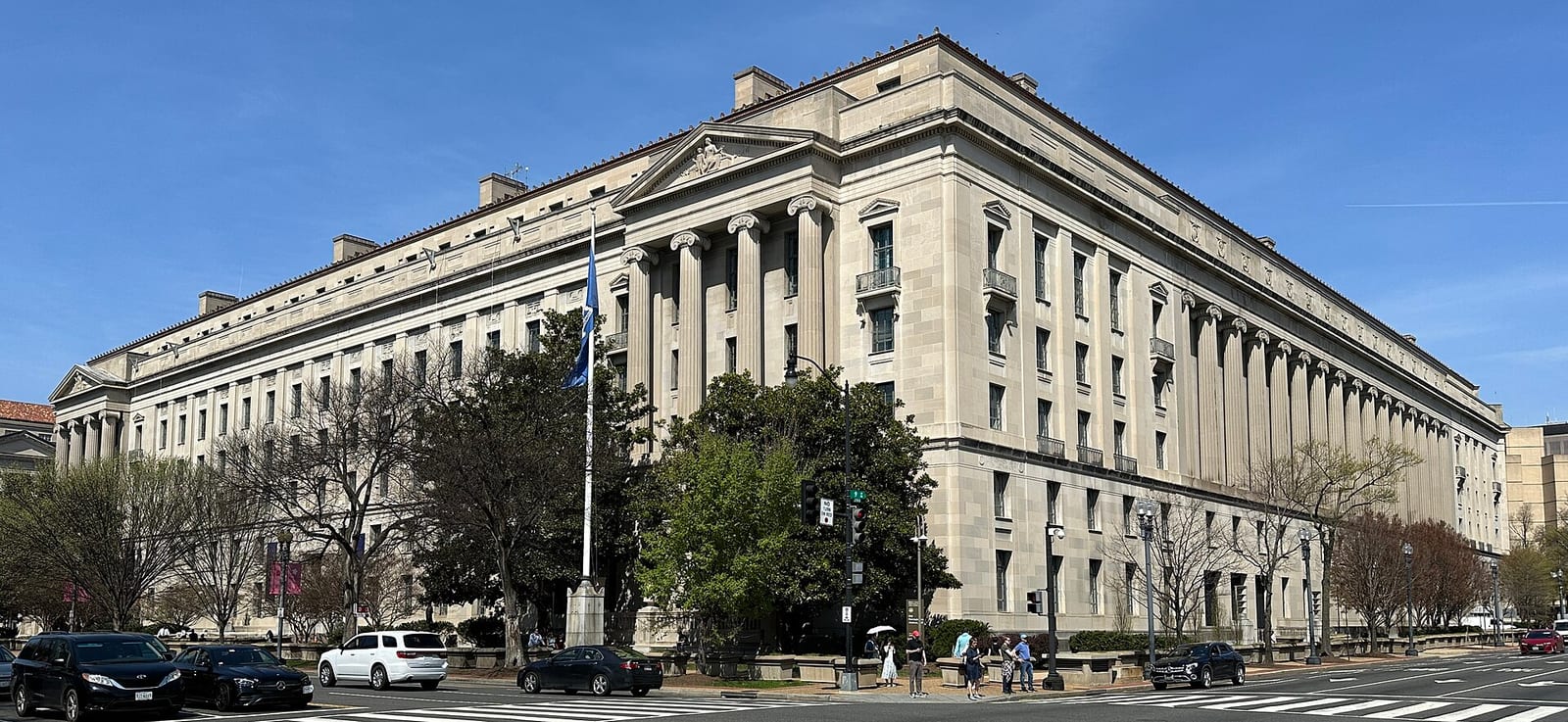
- Image credit: Robert F. Kennedy Department of Justice Building — APK, CC BY 4.0 via Wikimedia Commons.
Keep pulling the thread
See the receipts — free
Follow the money into Washington and back out again — foreign agents, federal contracts, donors, and the trades that track them. Free account: today’s top 10 signals + predictions. No card required.
Not financial advice. All data from public federal disclosures.